

 Back
Back
Stop bots.
Keep customers moving
Enterprise-grade bot protection tailored for small and medium sized businesses.
Block abuse before it reaches your website
without code changes and internal security team needed.
Built for SMB budgets without enterprise procurement cycles
THE PROBLEM
Modern bots don’t look like bots,
and SMBs feel the damage first
Ten years ago, a bot was easy to spot. It came from a data centre. It ignored
JavaScript. A simple blocklist stopped it. The internet has flipped.
Curious how a firewall differs
from real bot protection?
In numbers:


Bots are now the majority of web traffic – 53% in 2025, up from 51% the year before. Humans are the minority

Bad bots alone reached 40% of all traffic – a seventh straight year of growth

27% of bot attacks now target APIs – logins, checkout and payment endpoints, not just your home page

Bots rent residential proxies – the same home connections your customers use – so blocklists can’t tell them apart

AI tools now solve many CAPTCHAs faster than people, so a puzzle wall mostly slows your real buyers
For SMBs, this is not just a security problem. It’s cost, conversion and control.
What hurts before the owner ever sees an “attack”

Server resources get wasted
Your hosting, cache and database burn cycles on visitors who will never buy

CAPTCHAs punish real customers
Every puzzle adds friction while modern bots find ways around it

robots.txt is only a request
Search crawlers may obey it; unauthorised and AI crawlers can ignore it unless you enforce access technically. Compare robots.txt vs Bot Protection →

Generic DDoS protection
misses business-logic abuse
Layer-7 floods and slow attacks look like ordinary browsing until the app is already struggling

Dashboards become noise
Owners need clear answers – what was blocked, why, and what to change next – not raw logs
That is why the old defences keep failing. Blocklists can’t ban an IP your customers share. CAPTCHAs punish real buyers while automation adapts.
A classic firewall only checks requests against known attack signatures — a bot behaving “politely” walks straight in.
.SNIPPET DEFINITION
What is bot protection software?
Bot protection software is a security layer that identifies automated traffic (bots) before it reaches a
website, blocking malicious bots like scrapers, credential-testing tools, spam scripts, while letting real
visitors and good bots like Google pass through without friction.
Think of it as a doorman for your website: everyone gets looked at, troublemakers never get in, and
regular guests never notice the check.
.SMB positioning
Enterprise-grade protection
without enterprise overhead
ADPAL is tailored for SMBs that need serious bot protection now – not after a three-month procurement process, and not after hiring a security team

Tailored for SMBs
Built for businesses with no SOC, no full-time security engineer and no enterprise procurement cycle. Default policies are pre-configured, so you’re protected the moment you switch on

Enterprise-grade where it matters
Advanced bot detection, WAF, rate limiting and L7 DDoS mitigation
in one layer

Powered by BlackWall
The same engine protecting 2.5 million+ websites across 30+ countries is tuned for small-business budgets and setup

Minimal friction for real users
Most genuine users continue normally. Adaptive CAPTCHA appears only in rare, uncertain cases

Built to stay up
Multi-region deployment with automatic failover keeps your site online during traffic spikes and attacks

Clear dashboard and simple rules
See good vs bad traffic, top targets, threat sources and rule status without reading server logs
Running a store, SaaS, marketplace, media or lead-gen website? The goal is simple: keep real customers moving, keep approved search engines crawling, and keep unwanted automation outside.
How it works
One filter in front of your website
Traffic passes through ADPAL before it ever reaches your origin — flagged behavior is blocked in milliseconds, without a rule to write
STEP 1
Traffic arrives
Every request hits ADPAL first not your server
STEP 2
Analysis in under 50 ms
Each request is scored in real time. Faster than a blink
STEP 3
Bad bots are stopped
Blocked at the perimeter. Your server never spends a single CPU cycle on them
STEP 4
Clean traffic flows through
Customers, search engines and good bots pass without friction
STEP 5
Rules adapt
Detection updates automatically, while your team can still set business rules for crawlers, countries, endpoints and emergency modes
For your IT person: ADPAL is powered by the GateKeeper engine and runs as a reverse proxy. Detection combines behavioural analysis, device and request fingerprinting, signature matching, rate limiting and anomaly heuristics. The detection logic updates itself automatically – no lists to maintain, no rules to write from scratch.
Learn more: about the GateKeeper behind ADPAL or dive into the documentation
 Scraping
 AI crawler
Credential stuffing
Account Takeover
Search engine
Data Theft
AI crawler
Credential stuffing
Account Takeover
Search engine
Data Theft
 Human
Carding
Human
Carding
Powered by BlackWall
Fingerprinting
Bot Classification
DDoS Protection
Rate Limiting
AI Crawl Control
Human
 Search engine
 AI search
Human
AI search
Human
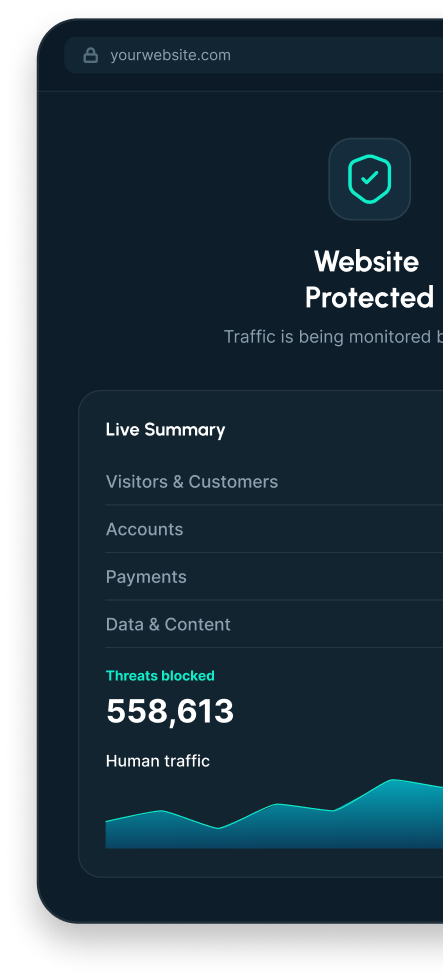
Everything SMBs need to keep bots out

Advanced protection engine
for SMBs

Invisible detection

Unauthorised crawler control

L7 DDoS mitigation

Rule settings without code

Speed is a bonus
Built-in WAF

Rate limiting & API protection

Dashboard you can actually read

Good bot allowlisting
.Control of AI crawlers

See what’s crawling you
Know which AI crawlers hit your site, how often, and whether they respect your rules

Control them crawler by crawler
Allow, limit or block each one, per site, with a toggle

Keep the ones that bring traffic
Verified AI-search crawlers – OpenAI, Anthropic, Perplexity, Google, Apple – that cite and link your pages stay welcome, so you show up in AI answers. The training scrapers that only take can be blocked

No impostors
We verify a crawler by its user-agent and its published network, so anything spoofing an AI bot’s name to sneak in is turned away
.Dashboard & rules
A dashboard your team can actually use
Most SMBs don’t need another log viewer. They need clear answers: how
much traffic is human, what is being attacked, which crawlers are allowed,
which rules are active, and whether the site is safer today than yesterday
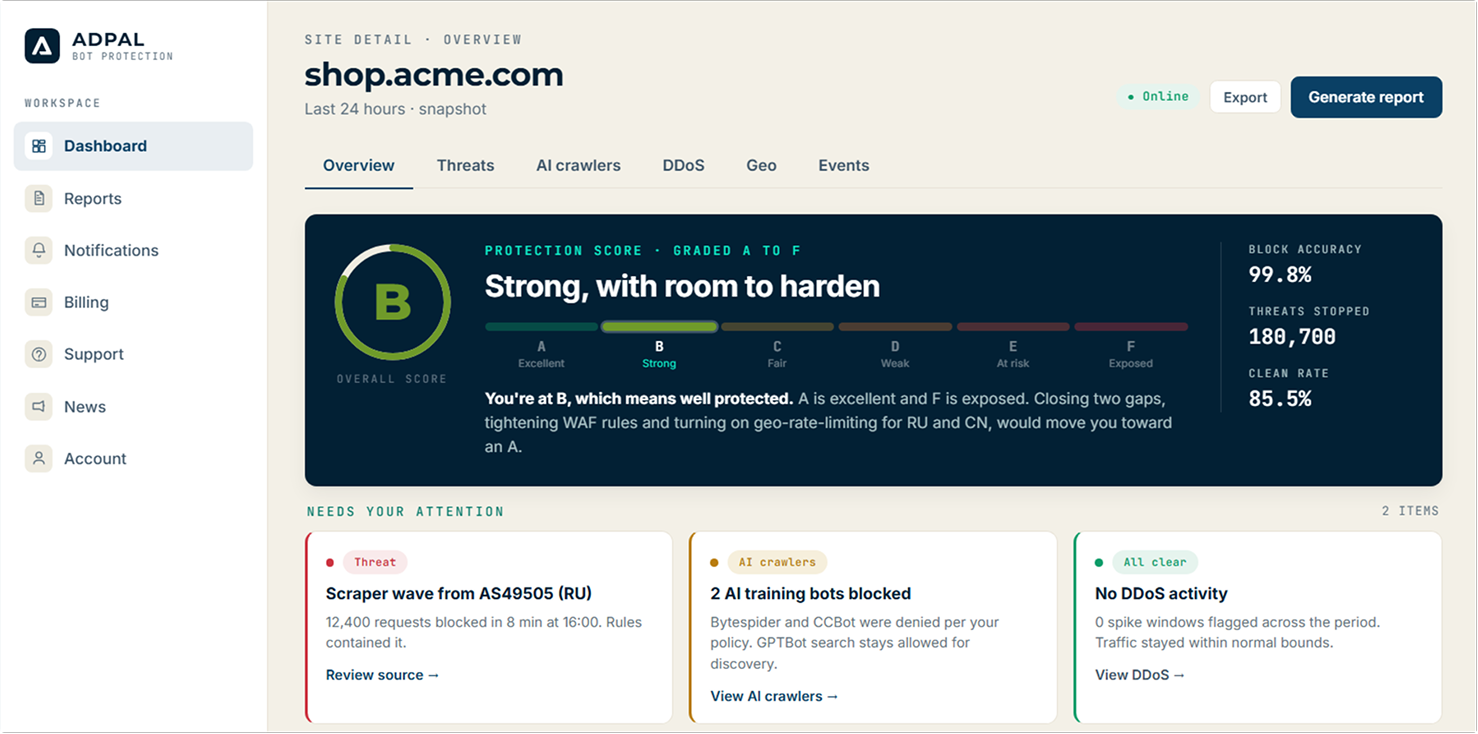

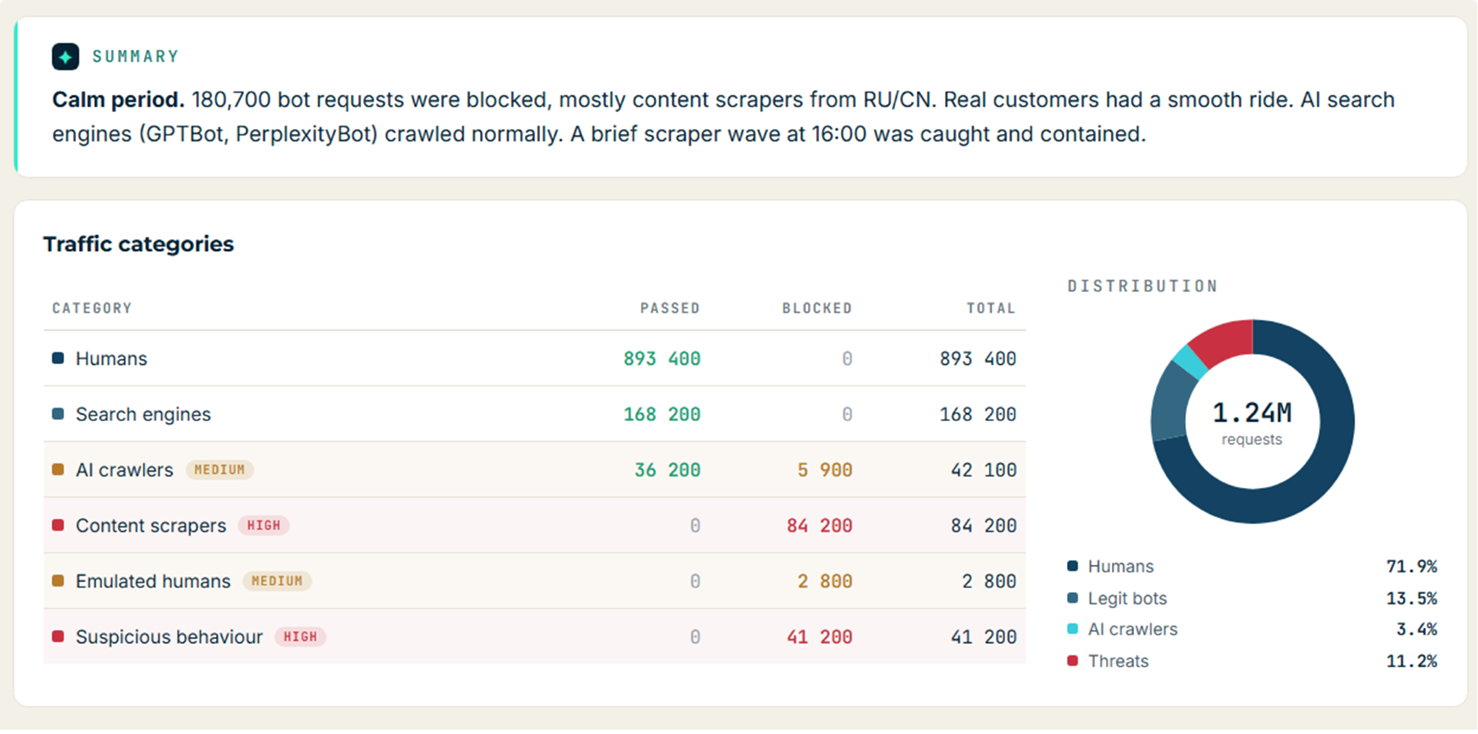
Human, good-bot, suspicious-bot and blocked traffic – split side by side, in real time

Threat sources by country, network, IP range and crawler type

A timeline of security events with custom date filtering, plus 8 built-in traffic categories

Top attacked pages and endpoints: login, forms, checkout, search and API paths

A recommended next step when traffic changes: tighten a rule, allowlist a bot, rate-limit an endpoint or switch on a stricter mode
Rule settings without waiting for developers

Allow Google, Bing and approved monitoring tools
Block or limit unauthorised crawlers and AI scrapers
Rate-limit login, forms, checkout, search and APIs
Create custom rules/rate limits for any unique architecture or needs
Block by country, ASN, IP range, path, user-agent or header
Create emergency rules during an L7 DDoS spike without touching application code

BUYER’S CHECKLIST
How to choose
bot protection software:
8 questions
Comparing vendors? Ask these – of anyone, including us:
Question
Why it matters
ADPAL
Does it detect by behaviour, not just IP lists?
Modern bots use residential IPs, real browsers and human-like patterns

Yes – behaviour + fingerprinting + anomaly heuristics
Does it work without CAPTCHAs?
Every puzzle can cost real conversions and still be bypassed by AI-assisted automation
Yes – CAPTCHA is adjusted to the specific case of the client
Does it include L7 DDoS mitigation?
Application-layer floods hit the app, not just the network
Yes – stopped before origin
Can it control unauthorised crawlers?
AI crawlers and scrapers may ignore robots.txt; enforcement needs a technical gate
Yes – crawler policies and rules
Is the dashboard understandable?
SMBs need decisions, not raw security logs
Yes – clear traffic, threat and rule views
Can rules be changed without code?
Teams need to react during abuse without waiting for developers
Yes – presets and custom rule settings
Is it priced and built for SMBs?
Enterprise platforms often mean enterprise cost, onboarding and complexity
Yes – SMB-first, BlackWall-powered
Is it GDPR-clean by design?
Security tooling should not create a new privacy burden
Yes – cookieless, EU residency, no visitor tracking
If a vendor can only answer these with “enterprise plan”, “custom project” or “ask security”, it may not be built for SMB reality
BOT PROTECTION SOFTWARE
Advanced bot protection
without enterprise complexity
Detect, manage and stop harmful automated traffic before it reaches your website, application or API


Bot detection
Identify automated traffic using behaviour, browser characteristics, network context, request sequence and endpoint activity

Bot management software
Separate useful automation from abusive traffic, then allow, limit or block requests according to your business rules

Anti-bot software
Stop scraping, account attacks, spam and other automated abuse at the perimeter before it reaches your application
Deployment:
Managed reverse proxy
DNS-based setup
CMS via hosting partners
First step today (free): run a website scan – see your current bot traffic before changing anything
.Trust
Privacy-first and SEO-safe by design
The key differenses


We let good crawlers to your business to make sure it’s visible to AI. Crawlers that train on your data are blocked

Approved search engines and monitoring tools pass through, so protection never breaks crawling, indexing or uptime checks
Most of these share one thing: they’re automated. Stop the automation, and you stop the attack at scale regardless of which route the attacker chose
Powered by BlackWall.
Trusted at serious scale.
ADPAL is powered by BlackWall technology protecting
2.5+ million websites in 30+ countries. The same enterprise-grade engine that shields large hosting platforms now protects small and medium-sized businesses at a price and setup model that fits.

< 50 ms decision time per request

2.5M+ websites protected by the underlying engine

SMB-first deployment: managed reverse proxy via DNS

30+ countries, with multi-region failover for high availability

Cookieless by architecture – no tracking cookies, no visitor profiles
.FAQ
Frequently asked questions
What does bot protection software actually do?
It sits in front of your website and inspects every incoming request. Automated traffic gets identified by behaviour and technical fingerprint; malicious bots are blocked, while customers and approved bots like Google pass through untouched.
What does enterprise-grade mean for an SMB?
It means ADPAL uses the same layered controls larger companies expect – behavioural detection, fingerprinting, WAF, rate limiting, L7 DDoS mitigation and automated updates – but packaged for teams without a dedicated security department.
What does “Powered by BlackWall” mean?
BlackWall is the underlying protection engine behind ADPAL’s request scoring and mitigation. It’s the technology that already protects millions of sites; ADPAL packages it for SMBs. (Exact wording and capitalisation to be confirmed by product/legal.)
How is this different from a WAF?
A WAF checks requests against known attack patterns – a guard with a wanted list. ADPAL also watches behaviour, catching bots that match no known pattern. It includes a WAF, plus bot detection, DDoS mitigation, unauthorised crawler control and rate limiting. See the full WAF comparison →
Can ADPAL stop unauthorised crawlers and AI scrapers?
Yes. ADPAL can tell approved search engines from unknown or unwanted crawlers, then block, limit or challenge them by your rules. That matters because robots.txt states a preference but doesn’t technically stop crawlers that ignore it.
Does ADPAL stop DDoS attacks?
Yes – at the application layer (Layer 7), where bot-driven floods hit your logins, forms, checkout and APIs. That’s where SMB sites usually fall over. For raw network-layer volumetric attacks you’d still lean on your host or CDN; ADPAL also lets you blacklist abusive IPs and networks at the perimeter.
Do small businesses really need bot protection?
Yes – often more urgently than enterprises. Bots scan the open web for logins, forms, checkouts and APIs. Large companies have security teams to absorb the damage; SMBs usually discover the problem after spam, slowdowns, fake accounts or chargebacks appear.
Will it slow down my site or block Google?
No. Analysis takes under 50 ms, and built-in caching plus HTTP/3 can make many sites faster. Google, Bing and other approved crawlers are allowlisted automatically, so SEO-critical crawling stays safe.
Can I manage rules without technical skills?
Yes. The dashboard is built for business owners and lean teams: plain-language stats, presets, rule settings and clear explanations – and 24/7 human support if you get stuck. If you can use Google Analytics, you can understand what ADPAL is doing.
What data do you store about my visitors?
We don’t set tracking cookies or build visitor profiles. We do keep standard request data – IP, user-agent, path and time – so you can see your own traffic and we can tune protection. It’s the same kind of data any web server logs, and cookieless means no new consent banner.
How long does deployment take?
Point your DNS at the managed reverse proxy – live in hours, then a short monitoring period before enforcing. CMS-integrated deployment is available through hosting partners.